
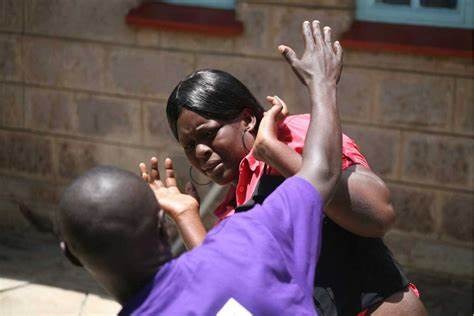
As the world marks International Women’s Day, the escalating cases of domestic violence and femicide in Nigeria cast a dark shadow over the celebration.
Violence in relationships is turning fatal, with women disproportionately affected.
A Disturbing Trend
In January 2025 alone, four femicide cases were reported, while five other women were disfigured. Between October and December 2024, 23 Nigerian women were murdered by their partners, according to reports from various media outlets.
Shocking Cases of Domestic Violence
One of the most horrifying incidents occurred on January 21, 2025, in Anambra State, where Sunday Nwana allegedly set his wife, Chioma Nwana, on fire over accusations of infidelity. She succumbed to her injuries the following morning.
In Benin City, Edo State, newlywed Kelvin Izekor allegedly murdered his pregnant wife, Success Izekor. A viral video showed police officers removing her lifeless body, revealing deep machete wounds on her head.
On January 14, 2025, Saheed Ganiyu, a 47-year-old vulcanizer, allegedly set his girlfriend, Esther, ablaze in Abuja. She survived but sustained life-altering injuries.
The day before, a 24-year-old National Youth Service Corps (NYSC) member, Salome Adaidu, was brutally murdered by her fiancé, Timileyin Ajayi, in Nasarawa State. Her body was dismembered, and the suspect accused her of infidelity.
Later in January, Sunday Echegi allegedly severed his wife’s left hand during a heated argument in Nsukka, Enugu State.
Robbery Gang Kills NYSC Member in Makurdi
Adding to the growing list of tragedies, three members of a robbery gang who allegedly killed a female NYSC member on the Makurdi-Naka road have been arrested by the police. This incident highlights the increasing dangers women face, not only in relationships but across society.
Statistics Reveal a Growing Crisis
Between September and December 2024, an average of eight domestic violence cases were reported monthly. In September alone, nine femicide cases occurred across Ogun, Kogi, Adamawa, Ondo, Edo, Delta, and Anambra states.
Unmarried partners accounted for 55.6% of reported domestic violence cases, compared to 33.3% among married couples. Women aged 25-38 were the most affected in intimate partner violence, while non-intimate partner violence affected girls as young as 17.
The Most Heartbreaking Cases
In one of the most devastating cases, Christana Idowu, a 21-year-old student of the Federal University of Agriculture, Abeokuta (FUNAAB), was allegedly murdered by Ayomide Adeleye, a student at Olabisi Onabanjo University.
Another case involved Ogechukwu Okafor, allegedly stabbed to death by her husband, Elijah Ibeabuchi, in Anambra State.
Beyond intimate partner violence, 19-year-old Damilola Olowoyo, a student of Federal University Lokoja, was kidnapped and murdered by Jeremiah Samson after a ransom payment.
In November and December 2024, 14 femicide cases were reported. Enugu State had the highest count, followed by Adamawa, Ogun, Bayelsa, Cross River, Ebonyi, Jigawa, and Plateau states.
One particularly gruesome case involved Malami Gebawa of Sokoto State, who allegedly broke his wife’s leg and hand for attending a clinic without his permission.
Calls for Action
Itoro Eze-Anaba, founder of Mirabel Center, stressed the need for widespread public awareness on domestic violence. She urged media houses, religious organizations, schools, community associations, and labor unions to actively engage in sensitization efforts.
“Cultural and societal norms prevent women from speaking out,” she stated. “Marriage is often seen as a symbol of success, making women reluctant to leave abusive relationships.”
Impact on Children
Educationist and child advocate Nneka Okeleke warned that children exposed to domestic violence often normalize aggression. This cycle can lead to behavioral issues, depression, and generational violence.
Legal Perspective
Legal expert Timothy Olamide explained that while Nigeria has laws against domestic violence, enforcement remains weak. Many cases are trivialized by law enforcement or settled out of court, preventing true justice for victims.
The Way Forward
As Nigeria celebrates International Women’s Day, the rising cases of femicide and domestic violence serve as a grim reminder of the urgent need for action. Stakeholders, including families, communities, law enforcement, and the judiciary, must work together to protect survivors and hold perpetrators accountable. Without decisive intervention, the cycle of violence will persist, claiming more lives.
From Corper’s Journey, we say: Enough is enough. Protect women. Stop the violence.
Story credit: Vanguard NG