
By Paul Chukwuebuka
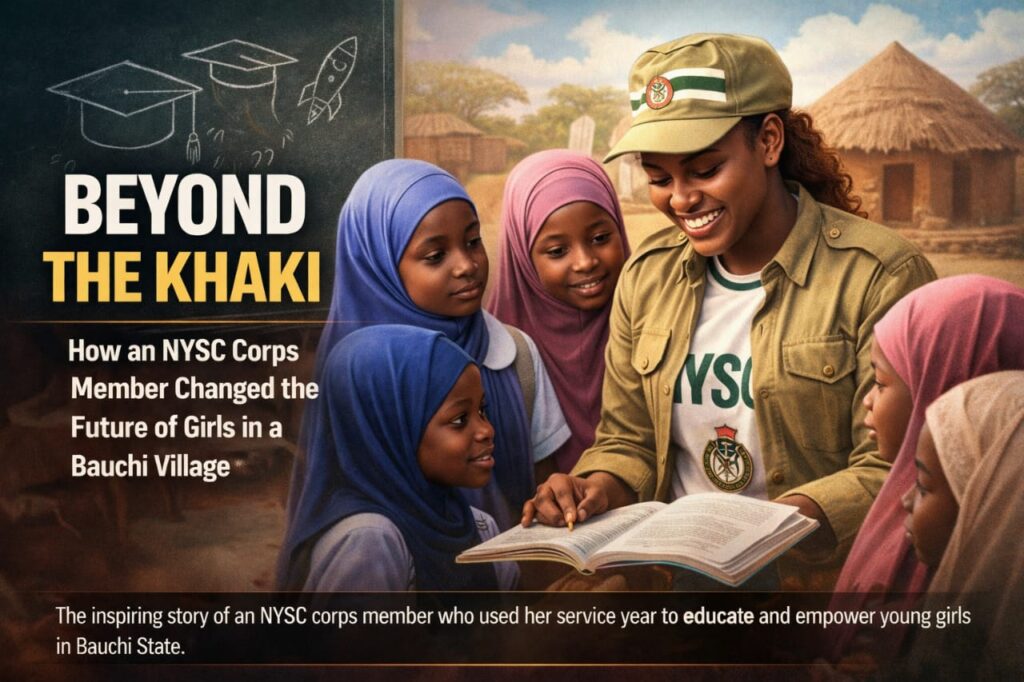
What began as a routine National Youth Service Corps posting for Adaeze Okafor in a rural Bauchi village soon grew into a community project that helped more than fifty girls learn basic computer skills, offering them their first exposure to technology and expanding their hopes beyond the classroom.
Adaeze’s journey began months earlier when she opened her call-up letter from the National Youth Service Corps.
“Bauchi State?” she whispered, her voice carrying both excitement and uncertainty.
Her mother looked over her shoulder and smiled.
“That is good. You will see another part of Nigeria.”
Adaeze had just graduated from Imo State University with a degree in Economics. Like thousands of Nigerian graduates each year, she was preparing to begin the one-year national service programme designed to expose young Nigerians to cultures beyond their regions.
Life at Orientation Camp
A few weeks later, Adaeze arrived at the orientation camp in Wailo, Bauchi State.
As she stepped off the bus, she saw hundreds of young Nigerians dressed in white vests and khaki trousers. Some were excited. Others looked exhausted from long journeys across the country.
“Corpers, move to the registration line!” a soldier shouted.
The familiar discipline associated with the NYSC programme had begun.
It did not take long for Adaeze to form friendships. She met Tunde Adeyemi from Lagos, Sadiq Musa from Kano, and Blessing Ekanem from Akwa Ibom. Though they came from different cultural backgrounds, they quickly bonded over shared experiences.
Camp life was demanding. Every morning began before sunrise with parade drills, marching exercises, and physical training supervised by soldiers.
Afternoons were reserved for lectures on leadership, national unity, and entrepreneurship. Evenings offered brief moments of relaxation as corps members shared food, laughter, and stories about life back home.
One evening, while sitting outside the hostel with bread and tea, Tunde jokingly pointed around the camp.
“This place,” he said, “is probably the only place where a Yoruba boy, an Igbo girl, and a Hausa guy will argue about who cooks the best jollof rice.”
The group burst into laughter.
For Adaeze, moments like that made the camp memorable. It was the first time she truly experienced Nigeria beyond her immediate environment.
The Posting
After three weeks, orientation camp came to an end, and the next stage of the programme began: posting.
Corps members gathered anxiously around the notice board as officials pinned the posting lists.
Adaeze eventually spotted her name.
Government Secondary School, Gwaram Village.
The village was located about two hours away from Bauchi city.
Nearby, her friend Blessing sighed loudly when she saw her own posting.
“I studied microbiology,” she said. “And they posted me to a primary school.”
Such mismatches are common across the country, where many corps members are assigned to roles that do not align with their academic training.
Adaeze, however, decided to remain optimistic.
Adjusting to Village Life
When she arrived in Gwaram village, the reality of rural life quickly became clear.
The school buildings were old, the chalkboards cracked, and electricity was inconsistent.
Still, the school principal, Mr. Bala, welcomed her warmly.
“You are our new corper,” he said. “You will teach economics.”
Adaeze felt relieved that her subject matched her field of study.
But a week later, the principal called her back.
“We need your help,” he said calmly. “You will also teach commerce and civic education, and supervise the debate club.”
Adaeze blinked in surprise.
“But sir, I was posted here for economics.”
Mr. Bala smiled.
“You are a corper. You will manage.”
It was one of the first lessons Adaeze learned during her service year: flexibility.
The Financial Reality
Another challenge soon followed — finances.
Although the federal government had recently increased the monthly allowance for corps members to ₦77,000, daily expenses quickly consumed most of it.
Transportation alone took a large portion of her allowance. Food prices were high, and electricity in the village remained unreliable.
Sometimes Adaeze checked her bank balance and laughed quietly.
“This service year will teach me financial discipline,” she often told herself.
To support herself, she began offering evening lessons to students in the community.
Word soon spread that the new corps member was a patient and dedicated teacher. Parents started sending their children for extra lessons, providing Adaeze with a modest additional income.
A Question That Changed Everything
Despite the challenges, Adaeze remained committed to her students. Many were intelligent and curious but had limited access to technology.
One afternoon during class, a student named Zainab raised her hand.
“Madam,” she asked quietly, “what is a computer like?”
Adaeze paused.
Some of the students had never seen or used a computer before.
The question stayed with her long after the class ended.
Teach One Girl Tech
A few weeks later, Adaeze launched a small project through her Community Development Service group.
She called it Teach One Girl Tech.
Every Saturday afternoon, she gathered girls from the community under a classroom veranda. Using a laptop borrowed from a friend in Bauchi city, she began teaching them basic computer skills.
At first, the girls were shy. Many had never touched a keyboard before.
Adaeze guided them gently.
“This is the keyboard,” she explained. “Each key represents a letter.”
Slowly, the girls began typing their names.
Their excitement was unmistakable.
Within a few months, more than fifty girls had attended the sessions. Some learned how to type simple documents. Others learned how to send emails.
Community Impact
News of the initiative soon reached the village head, who visited one Saturday to observe the lessons.
He watched quietly as the girls practiced typing.
After the class ended, he approached Adaeze.
“You have done something special for this community,” he said. “Our daughters now believe they can do more.”
His words stayed with her.
At that moment, Adaeze realised something important: the NYSC programme was not only about allowances or postings.
It was about impact.
The Final Months
As the months passed, Adaeze grew more confident. She built lasting friendships with fellow corps members across Bauchi State, many of whom shared similar stories of challenges and unexpected achievements.
During one Community Development Service meeting, Sadiq jokingly told the group:
“NYSC will humble you,” he said with a smile. “But it will also teach you how strong you are.”
Everyone nodded in agreement.
The Passing Out Parade
Eventually, the service year came to an end.
On the morning of the Passing Out Parade, Adaeze carefully pressed her uniform.
The same white outfit that once felt heavy with uncertainty now carried a different meaning.
She stood among hundreds of corps members during the ceremony, each with their own story of growth and resilience.
As the parade ended, Adaeze looked around and smiled quietly.
The year had not been easy. There were moments of loneliness, financial pressure, and unexpected challenges.
But there were also friendships, lessons, and a sense of purpose.
Later that evening, she wrote a final note in her journal.
“NYSC did not give me comfort,” she wrote. “It gave me courage.”
A Defining Experience
For many Nigerian graduates, the NYSC programme remains one of the most defining experiences of early adulthood. It brings young people from different backgrounds together and exposes them to communities they might otherwise never encounter.
Despite its challenges, the programme continues to offer opportunities for learning, cultural exchange, and service.
For Adaeze Okafor, the journey from orientation camp to passing out parade became more than a national assignment.
It became a chapter that reshaped her outlook on life, and reminded her that even a single borrowed laptop can open doors to new possibilities.